
INFORMATIONSTAFELN AUF LEVEL 0
Languages:
BAU DES FLAKTURMS IV
Mit den Luftangriffen auf Berlin startete am 10. Oktober 1940 das sogenannte Führer-Sofortprogramm für Bunkerbau. Adolf Hitler verfügte, dass zunächst in Berlin und 60 weiteren großen Städten Bunker zur Verteidigung kriegswichtiger Einrichtungen und Betriebe gebaut werden.
Die auf den Bunkern stationierten Flugabwehrkanonen (Flak) sollten feindliche Flugzeuge abwehren. Der Baubefehl für die zwei zusammengehörenden Flaktürme auf dem Heiligengeistfeld wurde am 17. Dezember 1941 erteilt. In Hamburg sollten 3 große FlakbunkerProjekte umgesetzt werden. Realisiert wurden letztlich nur 2 Standorte: Wilhelmsburg und dieser Bunker auf dem Heiligengeistfeld.

Im Vordergrund der später abgerissene Leitturm, der noch bestehende Gefechtsturm im Hintergrund
Wegen der zu erwartenden starken Rauchentwicklung und Erschütterungen durch die Flakgeschütze wurden jeweils Turm-Paare gebaut, bestehend aus dem Gefechtsturm mit den Geschützen und einem Leitturm für Funk- und Messgeräte. Errichtet wurden die Türme in der Zeit von März 1942 bis August 1943, wobei der Gefechtsturm bereits ab Juni 1943 für die Zivilbevölkerung freigegeben wurde. Die Bauarbeiten wurden von der „Organisation Todt“ ausgeführt, einer paramilitärischen Bautruppe. Architekt war Friedrich Tamm, der bereits die Flakbunker in Berlin geplant hatte.

Nachkriegsluftaufnahme der beiden Flaktürme
Die geplante Nutzung nach dem Krieg sah einen mit weißem Marmor verkleideten Prachtbau vor. Zu diesem Zweck wurden Fenster eingebaut, die während des Krieges jedoch verschlossen waren.
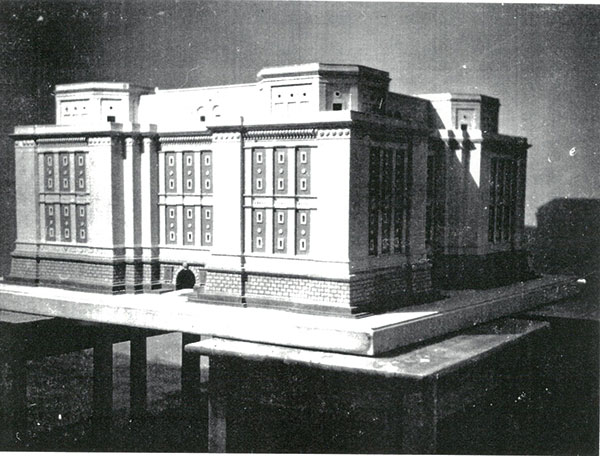
Modell des Bunkers als weißer Prachtbau
CONSTRUCTION OF THE FLAK TOWER IV
The air raids on Berlin on 10th October 1940 marked the start of the so-called Führer-Sofortprogramm (immediate program) for bunker construction. Adolf Hitler decreed that bunkers would initially be built in Berlin and 60 other large cities for the defense of facilities and companies important to the war effort.
The Flak anti-aircraft guns stationed on top of the bunkers were to fend off enemy aircraft. The construction order for the two anti-aircraft towers on the Heiligengeistfeld was issued on 17th December 1941. Three large anti-aircraft bunker projects were to be realized in Hamburg. In the end, only 2 locations were realized: One in Wilhelmsburg and this bunker at Heiligengeistfeld.
In the foreground the later demolished control tower, and in the background the combat tower which still stands today
Due to the expected heavy smoke and vibrations produced by the anti-aircraft guns, pairs of towers were built, consisting of a combat tower with the guns and a control tower for radio and measuring equipment. The towers were erected between March 1942 and August 1943, with the combat tower being opened to the civilian population as early as June 1943. The construction work was carried out by the ‘Todt Organization’, a paramilitary construction group. The architect was Friedrich Tamm, who had already planned the anti-aircraft bunkers in Berlin.
Post-war aerial photograph of the two Flak towers
The planned use after the war envisaged a magnificent building clad in white marble. Window placements were installed for this later purpose, however they remained closed during the war.
Model of the bunker as a magnificent white building
CONSTRUÇÃO TORRE FLAK IV
Com os ataques aéreos a Berlim, foi iniciado em 10 de outubro de 1940 o chamado Programa Urgente do Führer para construção de bunkers. Adolf Hitler ordenou a construção – primeiro em Berlim e depois, em 60 outras cidades grandes – de bunkers para a defesa de estabelecimentos e empresas importantes para a guerra.
Os canhões de defesa antiaérea (FLAK, acrônimo alemão de Flugabwehrkanonen) estacionados no bunker tinham a função de defesa contra aviões inimigos. A ordem de construção das duas Torres Flak ligadas entre si no Heiligengeistfeld foi dada em 17 de dezembro de 1941. Em Hamburgo, o plano era de construção de 3 grandes projetos de Torre Flak e, ao mesmo tempo, bunker. No fim, apenas dois desses projetos foram concretizados. Wilhelmsburg e este bunker no Heiligengeistfeld.
Em primeiro plano, a torre de controle posteriormente demolida; em segundo plano, a ainda existente “torre de combate” (Gefechtsturm)
Foi em decorrência das esperadas trepidações e esfumaçamentos por conta dos canhões de defesa antiaérea que se construíram as torres, respectivamente, em pares, as quais se constituíam em uma torre de combate com os canhões de artilharia e uma torre de comando para os aparelhos de transmissão e de medida. As torres foram levantadas no período entre março de 1942 e agosto de 1943, embora a torre de combate tenha sido liberada para a população civil já a partir de junho de 1943. Os trabalhos de construção foram conduzidos pela “Organização Todt”, uma tropa paramilitar de construção. O arquiteto responsável foi Friedrich Tamm, que já havia planejado o bunker-torre Flak em Berlim.
Fotografia aérea das duas Torres Flak
Para o pós-guerra, planejou-se um prédio suntuoso revestido por mármore branco. Para esse fim, foram construídas janelas, as quais, contudo, durante a guerra, permaneceram fechadas.
Modelo do bunker como prédio suntuoso